


What Is the SPIRITUAL GIFT OF MERCY?
Key Take-Outs
ONE: Definition & Origin - Romans 12:8 motivational gift for cheerful compassion, sensing emotional needs (eleeo: patient aid)
TWO: Core Characteristics - Strengths: Empathy, gentleness, restorative presence. Weaknesses: Over-absorption, boundaries—mitigate with wisdom
.
THREE: Biblical Examples - John (loving disciple), Good Samaritan (practical mercy), Mary (devoted rest)
FOUR: Identification & Development - Feel others' pain deeply; develop via prayer (Psalm 85:7), boundaries (Proverbs 4:23)
FIVE: Practical Applications - Suited for counseling, mentoring; fosters inclusive teams in faith leadership
Mercy is the seventh redemptive gift in Romans 12:6–8: a God-given ability to sense emotional and spiritual needs with deep empathy and respond with cheerful, patient compassion. The Apostle John, Ruth and Mary of Bethany show the gift, and it matures from absorbing other people's pain to empowering them.Source: Mercy article (definition; H2 "From Absorption to Empowerment").
The redemptive gift of Mercy is a sacred echo of the Father's tenderness.
Mercy doesn't just notice pain—it leans in. It doesn't rush to fix. It chooses to be present. When others feel uncomfortable in the tension, the Mercy person creates a safe space to simply be.
If you carry the Mercy gift, you're likely drawn to people who are hurting or misunderstood. You intuitively feel what others feel. You carry a holy sensitivity—a capacity to sit with sorrow, without judgment or agenda. That is no small thing. In fact, it's the heart of Jesus Himself.
Throughout the Gospels, we see this gift over and over again. Jesus weeping at Lazarus' tomb—even though He was about to raise him. Jesus kneeling beside the woman caught in adultery. Jesus embracing the leper, not just healing him. This is Mercy—love that lingers.
But the beauty of this gift also comes with a cost.
Mercy hearts can become overwhelmed. They may take on burdens that were never theirs to carry. They may avoid confrontation for fear of causing pain—even when truth is needed. And in the desire to comfort others, they can lose themselves.
When matured, however, Mercy becomes a powerful reflection of God's presence. They shift atmospheres. They disarm shame. They remind the world that even in its mess, it is still seen, known, and loved.
Let's enter into this sacred space together.
This article is part 8 of the 12-Part Awakened by Design Redemptive Gifts series, exploring how Romans 12:6–8 reveals your unique spiritual DNA.
If you’re new to the series, I recommend starting here:
- The Redemptive Gift of Prophet
- The Redemptive Gift of Servant
- The Redemptive Gift of Teacher
- The Redemptive Gift of Exhorter
- The Redemptive Gift of Giver
- The Redemptive Gift of Ruler
I highly recommend signing up to the full series on exploring the Redemptive Gifts Series below.

Now, we turn to the Mercy, the divine carrier of the Father's heart.
The Redemptive Gift of Mercy – Heaven's Healing Presence
Consider the story of Ruth. She was a Moabite widow who had every reason to return to her own people, her own gods, and start over. Instead, she clung to Naomi—her bitter, broken mother-in-law—and chose loyal love over self-preservation.
"Where you go I will go, and where you stay I will stay. Your people will be my people and your God my God." — Ruth 1:16
Ruth didn't just speak comfort—she embodied it. She stayed in the grief. She worked in the fields to provide. She created safety for Naomi's wounded heart through unwavering presence and practical devotion.
This is the heart of Mercy. Not grand gestures or eloquent words, but a steadfast commitment to stay when others leave, to feel when others shut down, and to love when it's inconvenient.
That is the essence of the Mercy gift. You may not have all the answers, but you care deeply about holding space for those who are suffering—and that changes everything.
As Mother Teresa, a modern embodiment of this gift, once said: "Not all of us can do great things. But we can do small things with great love."
SO, What Is thE SPIRITUAL GIFT OF MERCY?
The spiritual gift of mercy (from Romans 12:8, Greek:eleeo, meaning "to have compassion" or "to show kindness to the afflicted") is a God-given ability to sense emotional and spiritual needs with deep empathy and respond with cheerful, patient compassion that brings healing and restoration. It is a gift of presence—creating sacred space where others encounter God's love.
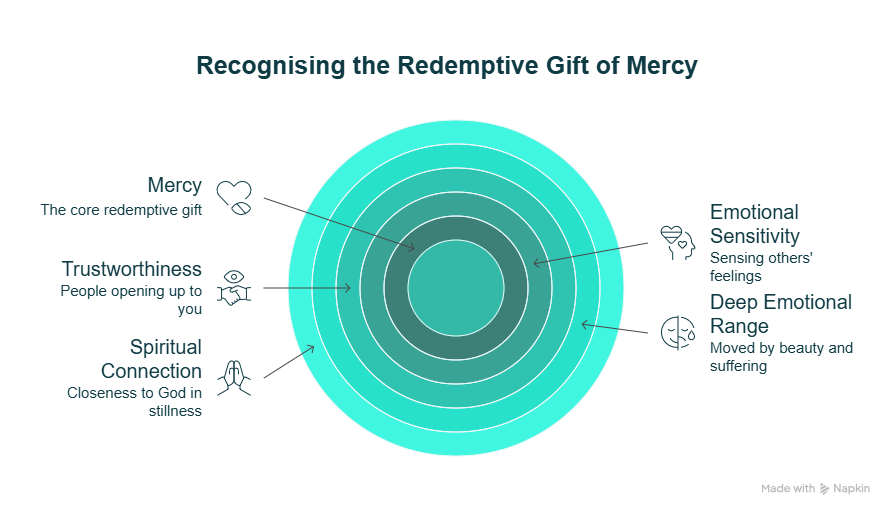
5 Ways to Recognise the Redemptive Gift of Mercy
You might carry the Mercy gift if you consistently find that:
Immature vs. Mature Expression OF THE mercy GIFT
The Mercy's journey moves from absorption to empowerment, from emotional overwhelm to healing presence.
Immature Expression
Mature Expression
"Mercies are designed to feel deeply, but wounds can distort this into codependency. A mature Mercy guards their heart while staying open," says Arthur Burk, former founder of Sapphire Leadership Group.
Why Do Mercies Struggle with Boundaries and Emotional Overload?
Mercies often carry the weight of emotional labor so deeply that they struggle to distinguish between empathy and absorption. This isn't weakness—it's often born from a beautiful desire to alleviate suffering and a fear that setting boundaries means withholding love.
This wound can create a pattern where the Mercy becomes emotionally exhausted, resentful, or lost in others' stories. They may enable unhealthy behavior because they can't bear to see someone in pain, even when that pain is the consequence of their choices.
Mature Mercies learn that boundaries aren't walls—they're gates. They understand that self-care isn't selfish; it's stewardship. They recognize that sometimes the most loving thing they can do is allow someone to experience the natural consequences of their decisions while still offering compassionate support.
How to Use the Spiritual Gift of Mercy Without Burnout
Mercies avoid burnout by learning to guard their hearts while staying tender. The weight of feeling everyone's pain—the fear of causing hurt, the pressure to fix what's broken—can crush Mercies. To thrive:
- Distinguish between empathy and absorption: Feel with people, not for them (Romans 12:15)
- Create rhythms of solitude: Regular time alone to process and release what you've carried (Mark 1:35)
- Practice discernment in giving: Not every need is yours to meet; ask God who and when (John 5:19)
- Build a support system: Have people who pour into you, not just those you pour into
This approach ensures Mercies lead from fullness, not depletion, creating Kingdom impact that endures.
Fractal Alignment: Four Examples of the Fractal Pattern in Scripture
In this series, we connect each gift to a "biblical fractal"—a recurring pattern God has woven into creation and His Word. The Mercy is the seventh gift, resonating with the number seven, which often symbolises completion, rest, and divine perfection.
1. Day of Creation: The Sabbath Rest (Genesis 2:1-3)
"By the seventh day God had finished the work he had been doing; so on the seventh day he rested from all his work. Then God blessed the seventh day and made it holy, because on it he rested from all the work of creating that he had done." — Genesis 2:1-3
Reflection: On the seventh day, God rested—not because He was tired, but because the work was complete and it was good. He created space for presence, for being rather than doing. This is the essence of the Mercy gift. They understand that sometimes the most powerful thing you can offer is simply to be present. Their gift isn't about activity—it's about atmosphere. A mature Mercy creates Sabbath space for weary souls, offering rest in the presence of God through their compassionate attention.
2. Tabernacle Item: The Mercy Seat (Exodus 25:17-22)
"Make an atonement cover of pure gold... There, above the cover between the two cherubim that are over the ark of the covenant law, I will meet with you and give you all my commands for the Israelites." — Exodus 25:17, 22
Reflection: The Mercy Seat was the most sacred space in the Tabernacle—the place where God's presence dwelt and where atonement was made. It was literally called "the place of mercy" (kapporeth). For the Mercy gift, their presence creates a mercy seat for others—a sacred space where people encounter God's compassion, forgiveness, and restoration.
They don't just offer sympathy; they become a living sanctuary where broken hearts find acceptance and healing. A mature Mercy understands they carry God's presence, not just their own emotions.
3. Tree from Isaiah 41:19: The Box Tree (Cypress)
"I will put in the desert the cedar and the acacia, the myrtle and the olive. I will set pines in the wasteland, the fir and the box together..." — Isaiah 41:19
Reflection: The box tree (often translated as cypress) was valued for its fragrant oil and its use in creating places of beauty and peace. In ancient times, its wood was used for making musical instruments and sacred objects. This reflects the Mercy's anointing—they bring beauty, fragrance, and worship into barren places. Like the box tree that releases its fragrance when crushed, Mercies often minister most powerfully out of their own suffering. Their pain becomes an offering, and their presence creates an atmosphere of worship and healing in spiritual wastelands where others see no hope.
4. "I Am" Statement of Jesus: "I am the TRUE VINE" (John 15:1, 5)
"I am the true vine, and my Father is the gardener... I am the vine; you are the branches. If you remain in me and I in you, you will bear much fruit; apart from me you can do nothing." — John 15:1, 5
Reflection: This is Jesus's declaration of intimate, life-giving connection. The Mercy gift is uniquely designed to understand and embody this truth—that fruitfulness comes from abiding, not striving.
Mercies naturally create environments where others feel connected, nourished, and safe to grow. They understand that their power comes from remaining in God's presence, not from their own efforts.
When a Mercy stays rooted in the Vine, they become a conduit of divine life to everyone around them. Their gift flows best when they're abiding, not achieving.
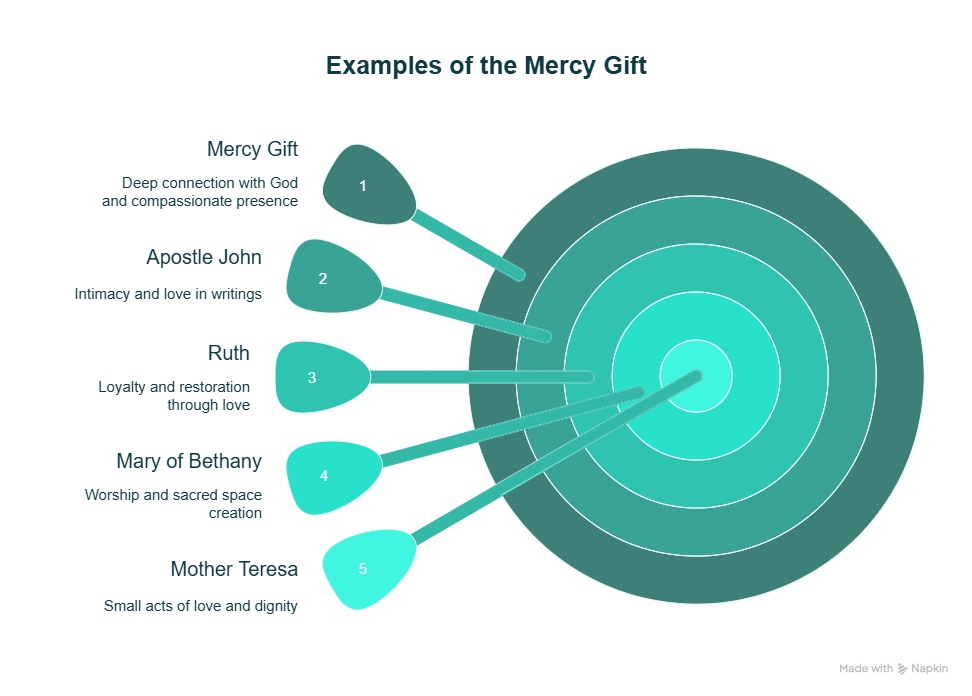
Three Biblical and One Modern-Day Examples of the Mercy Gift
1. Apostle John (John 13:23; 1 John 4:7-21): The Beloved Disciple
John was known as "the disciple Jesus loved"—not because Jesus loved him more, but because John's heart was uniquely attuned to receiving and reflecting that love. He leaned on Jesus's chest at the Last Supper, seeking intimacy over information. In his later writings, John emphasized love above all else:
"Dear friends, let us love one another, for love comes from God. Everyone who loves has been born of God and knows God." — 1 John 4:7
John didn't lead through strategy or systems—he led through relational depth and compassionate presence. His gospel and letters overflow with tender language about abiding, knowing, and loving. This is the Mercy gift in its mature expression: deep connection with God that overflows into healing presence for others.
2. Ruth (Ruth 1-4): Loyal Love Personified
Ruth was a Moabite widow who had no obligation to stay with her bitter mother-in-law Naomi, yet she chose loyal love (hesed) over self-preservation:
"But Ruth replied, 'Don't urge me to leave you or to turn back from you. Where you go I will go, and where you stay I will stay. Your people will be my people and your God my God. Where you die I will die, and there I will be buried. May the Lord deal with me, be it ever so severely, if even death separates you and me." — Ruth 1:16-17
Ruth didn't just speak comfort—she embodied it through practical devotion. She stayed in Naomi's grief, worked to provide for her, and ultimately became part of the lineage of Christ. Her loyalty and compassion brought redemption to a broken situation. This is the Mercy gift's power: to stay when others leave, to serve without recognition, and to bring restoration through steadfast love.
3. Mary of Bethany (Luke 10:38-42; John 12:1-8): The Worshiper
Mary chose to sit at Jesus's feet when her sister Martha was busy serving. Later, she anointed Jesus with expensive perfume in an extravagant act of worship—pouring out what was valuable to honor Him:
"But only one thing is needed. Mary has chosen what is better, and it will not be taken away from her." — Luke 10:42
"Then Mary took about a pint of pure nard, an expensive perfume; she poured it on Jesus' feet and wiped his feet with her hair. And the house was filled with the fragrance of the perfume." — John 12:3
Mary understood what others missed: presence is more important than productivity. Her worship filled the room with fragrance, just as Mercies fill atmospheres with God's presence. She ministered to Jesus's heart through intimate devotion, not efficient service. This is the Mercy's call—to prioritize intimacy with God and create sacred space for others to encounter Him.
4. Mother Teresa (Modern Example): Small Things with Great Love
Born Agnes Gonxha Bojaxhiu in 1910, Mother Teresa founded the Missionaries of Charity and spent her life serving "the poorest of the poor" in Calcutta, India. She didn't build hospitals or feed thousands at once—she held dying people in her arms, one at a time, ensuring they didn't die alone.
Her approach perfectly demonstrates the Mercy gift: she saw the face of Christ in suffering people and ministered presence, dignity, and love to those society had discarded. Despite her own spiritual darkness (revealed in her private letters), she continued to show up with compassionate service daily.
"Not all of us can do great things. But we can do small things with great love." — Mother Teresa
"If you judge people, you have no time to love them." — Mother Teresa
Her leadership created a global movement not through strategy, but through faithful, compassionate presence. She demonstrated that Mercies don't change the world through grand gestures—they change it one tender encounter at a time.
Note: While Mother Teresa has not been formally assessed through redemptive gifts frameworks, her life's work, approach to ministry, and consistent prioritisation of compassionate presence over productivity strongly align with the characteristics of the Mercy gift as described in Romans 12:8.
The Mercy's Unique Call to Heal Atmospheres
One of the most powerful and often unseen aspects of the Mercy gift is their divine capacity to shift spiritual atmospheres through their presence. While other gifts may change environments through action or words, the Mercy transforms spaces simply by showing up aligned with God's heart.
This is heaven's strategy for healing through presence. However, this gift can become distorted. When a Mercy absorbs pain without releasing it to God, they become a sponge rather than a conduit. They may enable dysfunction by providing comfort that prevents necessary growth, or they may avoid truth-telling because they can't bear to cause discomfort.
A mature Mercy learns to navigate this tension with wisdom—feeling deeply without drowning, comforting without enabling, and creating space for both grace and truth. They understand that sometimes the most merciful thing they can do is speak a hard truth wrapped in love, or allow someone to experience consequences while still offering compassionate support.
"Mercies sense what others miss—the unspoken pain, the hidden shame. But maturity teaches them to distinguish between empathy and absorption, so they can heal without being destroyed," says Arthur Burk.
Early Wounds That Shape the Mercy's Authority
Emotional Invalidation
Growing up in an environment where emotions were dismissed, mocked, or punished can create a deep-seated fear of expressing feelings. This can lead to a Mercy either shutting down emotionally or becoming hyper-attuned to everyone else's emotions while neglecting their own.
Responsibility for Others' Feelings
A significant wound for a Mercy is being made responsible for managing others' emotional states—constantly walking on eggshells, fixing moods, or preventing conflict. This teaches them that love means absorbing pain, leading to codependency and emotional exhaustion.
Betrayal of Trust
Witnessing or experiencing situations where vulnerability was met with cruelty, abandonment, or manipulation can deeply wound a Mercy's core desire for safe connection. This can cause them to either over-give to prove their loyalty or withdraw completely to protect themselves.
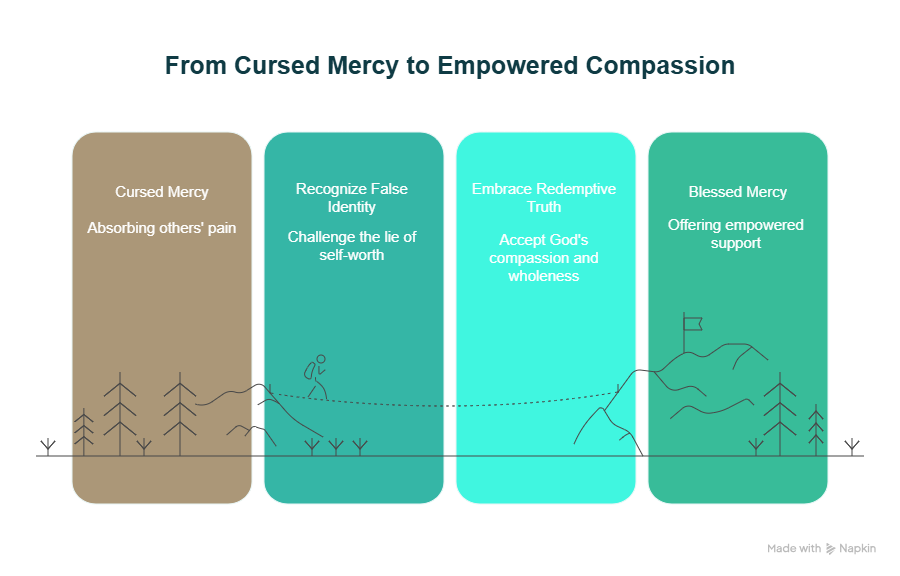
The Mercy's Curse: From Absorption to Empowerment
The Curse of the Mercy
When operating out of wounds of fear and codependency, the Mercy's gift becomes a curse that produces:
- Emotional Enmeshment: Their boundaries dissolve, making it impossible to distinguish their feelings from others'
- Enabling Dysfunction: Their compassion prevents necessary consequences, keeping people stuck
- Identity Loss: They become so focused on others' needs that they lose themselves entirely
The False Identity
At the root of the curse is a lie that whispers: "My value is in absorbing others' pain. If I set boundaries, I'm unloving. If I can't fix their hurt, I've failed."
The Redemptive Truth
But the Spirit of God whispers a deeper truth: "You were made to reflect My compassion, not become the savior. Your empathy is a gift, not a burden. You can feel deeply and still be whole."
The Blessing of the Mercy
A healed Mercy:
- Creates Healing Presence: They shift atmospheres and disarm shame simply by showing up with God's heart
- Embodies Wisdom and Compassion: They know when to comfort and when to confront, speaking truth in love
- Offers Empowered Support: They walk with people through pain without carrying what isn't theirs
"Blessed are the merciful, for they will be shown mercy." — Matthew 5:7
The Mercy in Leadership: From Caretaker to Culture-Shaper
A leader with a Mercy gift brings a unique and transformative power to any team or organization. Their journey is about moving from being a caretaker (fixing everyone's feelings) to becoming a culture-shaper (creating environments where people feel safe to be human).
1. Leading Teams
A Mercy leader excels at creating psychological safety. They instinctively sense team dynamics, notice when someone is struggling, and create space for vulnerability. They build cultures where people feel valued as whole humans, not just productivity machines. The primary challenge for a Mercy leader is to not sacrifice clarity or accountability for the sake of emotional comfort—they must learn that truth and love are not opposites.
2. Influencing Culture
Mercy leaders create cultures of compassion, inclusion, and emotional intelligence. They model what it means to honor dignity, celebrate diversity of expression, and lead with empathy. They create environments where people don't have to hide their humanity to be professional. When a Mercy leads well, loyalty, creativity, and engagement soar because people feel truly seen.
3. Avoiding Burnout
The Mercy's burnout doesn't come from working too hard—it comes from absorbing too much. They can be destroyed by carrying emotional weight that isn't theirs, avoiding necessary conflict, or neglecting their own needs to meet everyone else's. Their path to resilience is to continually release what they've carried to God, set loving boundaries, and remember that they're a conduit of His mercy, not the source.
Navigating the Future - Two Future Disruptors for MERCIES
As faith-based leaders look ahead, several cultural currents will demand specific spiritual solutions. The mature Mercy is uniquely designed by God to address some of the most significant challenges on the horizon.
1. The Mental Health Crisis and Emotional Fragmentation
As rates of anxiety, depression, and loneliness skyrocket—especially post-pandemic—there is a desperate need for leaders who can create emotionally safe spaces. The Mercy's divine capacity to offer non-judgmental presence, validate struggle without fixing it, and create sanctuary for the broken will become critical in workplaces, churches, and communities hungry for genuine compassion.
2. The Rise of Cancel Culture and Polarization
In a world increasingly divided by outrage and judgment, the Mercy's anointing to extend grace without condoning sin will be essential. They are the ones who can model what it looks like to hold space for messy humanity while still upholding truth—creating bridges in a culture that only knows how to build walls. Their gift offers a third way: compassion that doesn't compromise.
Warfare Wisdom for The mercy Gift
The primary attack against the Mercy is on their sense of emotional boundaries and identity. The enemy tempts them to find their worth in being needed, to confuse compassion with codependency, and to believe the lie that setting boundaries means withholding love.
- The Lie: "If I don't absorb everyone's pain, I'm unloving. My value is in being needed. If I set boundaries, I'm selfish."
- The Truth: "My security is in God, who is the source of all mercy. My value is in my identity as His beloved child, not in what I can do for others. Boundaries are an act of stewardship, not selfishness."
- The Strategy: Practice emotional release through worship and prayer—especially when you feel overwhelmed by others' pain. Regularly ask God, "What's mine to carry, and what's Yours?" This is a spiritual act of war against the spirit of Codependency and a declaration that you are a conduit, not a container.
- The Declaration: "I renounce the need to fix everyone and the fear that boundaries mean I'm unloving. My compassion flows from God's heart, not my own effort. I am empowered to feel deeply and remain whole. I guard my heart so I can continue to pour out His mercy."

SELF REFLECTION JOURNAL PROMPTS
- Do I avoid conflict, or do I bring peace through truth? Where have I enabled dysfunction because I couldn't bear to see someone uncomfortable?
- Where have I taken on weight that wasn't mine to carry? What burdens am I holding that God never asked me to hold?
- When do I feel most connected to God's presence? What environments, practices, or relationships help me stay rooted in the Vine
- Am I protecting people from pain—or walking with them through it? Is my compassion empowering growth or preventing it
- What would it look like to guard my heart while staying tender? How can I set boundaries without shutting down?
Practical Steps for Growing Your MERCY Gift
- Practice Emotional Release: After spending time with someone in pain, intentionally release what you've absorbed through worship, prayer, or journaling. Ask God, "What's mine, and what's Yours?
- Set Compassionate Boundaries: Identify one relationship where you're enabling dysfunction. Practice saying "no" with love, or allowing natural consequences while still offering support.
- Create Rhythms of Solitude: Schedule regular time alone to rest in God's presence without any agenda. Let Him fill you so you can pour out from overflow.
- Discern Before Diving In: Before rushing to comfort or fix, pause and ask God: "Is this mine to carry? What does this person actually need—comfort or truth?"
A Prayer FOR MERCY
Father, thank You for the gift of Mercy—the one who reveals Your heart through compassion, presence, and peace.
I ask You to show me if this is the redemptive gift You've placed in my soul. Lord, I ask You to break off codependency, avoidance, and the weight of false burdens. I ask You to rebuke the lie that I must absorb everyone's pain to be useful, and I reject and renounce from this moment forward and into eternity every spirit that twists empathy into exhaustion.
Jesus, cover this prayer with Your blood. Let Your presence surround and strengthen me. Empower me to bring healing through quiet strength, to stand in storms without sinking, and to love with wisdom and boundaries. Let my life reflect Your comfort, and may others encounter Your embrace through me.
In Your name, I pray. Amen.
The spiritual gift of mercy invites you into God's tender heart, transforming sensitivity into a superpower for healing and unity. By embracing its cheerful call amid challenges like emotionality, you'll create sanctuaries where the hurting find rest—echoing Christ's compassion (Matthew 25:40).
Align it with wisdom for lasting Kingdom fruit.
In our next article, we'll be looking at the curses and blessings of each of these Gifts and what you can do to overcome the negative to allow the positive to flow in your life.
Let me know your questions, comments and insights by sharing in the reply box below.
Yours in Christ,


And if you want to go deeper on discerning whether you're operating from your true gift or from armour, the Designed for Destiny workbook walks you through exactly this — including gift-specific healing prayers and a 30-day practice.
References & Further Reading
For those who wish to study further, the following resources were consulted or are recommended for deeper understanding of the concepts discussed in this article
- Burk, Arthur. (n.d.). Redemptive Gifts: Mercy. Sapphire Leadership Group. Retrieved from https://theslg.com/content/redemptive-gifts-mercy
- Holy Bible, New International Version. (2011). Romans 12:8. Zondervan. Available via https://www.biblegateway.com/passage/?search=Romans+12%3A8&version=NIV
- Stanley, Charles. (1999). The Spirit-Filled Life: Discovering the Joy of Surrendering to the Holy Spirit. ISBN: 978-0785274427. Thomas Nelson
- Institute in Basic Life Principles. (2023). What is the Spiritual Gift of Mercy?. Retrieved from https://iblp.org/what-spiritual-gift-mercy/
- GotQuestions.org. (2011). What is the spiritual gift of mercy?. Retrieved from https://www.gotquestions.org/gift-of-mercy.html
Faq's for what is the SPIRITUAL gift of MERCY?
From Romans 12:8, it's a God-given ability to empathise deeply with suffering and respond cheerfully with compassion (eleeo: patient toward the afflicted). It reflects Christ's mercy (Matthew 5:7), sensing emotional needs to alleviate pain and foster healing.
From Romans 12:8, it's a God-given ability to empathise deeply with suffering and respond cheerfully with compassion (eleeo: to show patient kindness toward the afflicted). It reflects Christ's mercy (Matthew 5:7), sensing emotional needs to alleviate pain and foster healing through presence.
Apostle John (the disciple Jesus loved, emphasising love in 1 John 4:7-8), Ruth (loyal compassion to Naomi, Ruth 1:16-17), and Mary of Bethany (worshipping at Jesus's feet, Luke 10:39; John 12:3). They embody cheerful mercy and healing presence amid suffering.
It humanises the church, providing sanctuary for the hurting (Matthew 25:40: "What you did for the least, you did for Me"). It prevents isolation, advances Kingdom healing, and creates emotionally safe environments where people encounter God's love (Ephesians 4:16).
Mercy feels and absorbs emotional needs (vs. Ruler's structure or Prophet's discernment). Unlike the Exhorter who motivates through challenge, Mercy comforts through presence. All gifts complement each other (1 Corinthians 12:22: "Weaker parts are essential") to create unity in the body.
Notice deep emotional resonance with others' pain, joy in comforting, or fatigue from absorbing emotions. Reflect on Romans 12; use faith-based assessments (e.g. Arthur Burk's tools). Pray for Holy Spirit confirmation (John 16:13) and seek feedback from trusted mentors.
Common pitfalls include emotional overwhelm ("stronghold of emotionality"), over-absorption of others' pain, people-pleasing, and avoiding necessary confrontation. Faith solution: Set boundaries (Proverbs 4:23: "Guard your heart"), renew your mind (Romans 12:2), and distinguish empathy from absorption.
Yes, through prayer, Scripture meditation (e.g., Psalm 85:7 for God's mercy), and practising cheerful compassion with wisdom. Mature Mercies guard their hearts while staying tender, turning sensitivity into empowered healing through spiritual disciplines (2 Timothy 1:7).
To extend God's restorative love, creating sacred spaces where others encounter His compassion (Hosea 6:6: "I desire mercy, not sacrifice"). It mobilises empathy for healing, justice, and emotional health in the body of Christ, fulfilling Romans 12:8's call to show mercy cheerfully.
Respond cheerfully (Romans 12:8), balance compassion with wisdom (James 1:5), and delegate emotional overload to God. In leadership, foster psychologically safe teams while maintaining accountability. Avoid codependency through self-care and regular time in God's presence.
Counseling, nursing, pastoral care, hospice work, social work, or mentoring. Biblically, it's stewardship of compassion (Matthew 25:35-40), excelling where empathy heals and presence transforms—like Mother Teresa's legacy of "small things with great love."
Mercies naturally possess high emotional intelligence—they sense unspoken feelings, create psychological safety, and navigate complex relational dynamics. In leadership, this translates to building engaged, loyal teams where people feel valued. When matured with boundaries, it becomes a powerful professional asset.
Absolutely. In today's workplace, emotional intelligence is critical. Mercies who learn to balance compassion with accountability create cultures of trust, innovation, and loyalty. They transform organisations by making people feel truly seen while still driving results—a rare and valuable combination.
awakened by design redemptive gift Series


A Note on the Origins of This Teaching:
The Redemptive Gifts framework we explore in this series has a rich history. We are indebted to the foundational work of several contributors, including the initial concepts delineated by Bill Gothard, the insightful discovery of scriptural parallels by Judy Lee, and the extensive popularisation of the framework by Arthur Burk.
While we acknowledge this historical development, our focus in this series is to explore the biblical integrity and transformative power of the framework itself. We aim to present this as a tool for understanding your God-given design, allowing the truth within the message to stand on its own merit.
Links to Other FAITH-BASED ARTICLES:
- 9 Biblical Qualities of a Good Leader
- How to Heal a Distorted View of Father God due to our own father wounds
- Leadership and New Beginnings based on Scripture

My sisters and I have been sharing the concepts of redemptive gifts with our discipleship group and it's been exciting to watch people have light bulb moments. One of the girls is a mercy and was going through the giftings struggling to find what fit. She thought maybe exhorter because she's a people person, then considered being a prophet for a while. We held back in telling her what she was because we wanted her to go on the journey, which happens to be a struggle for a mercy because they don't like surprises! It seems like the desire for completion is so strong that it even comes out in little ways, such as she has a hard time with suspense. This past week I got to spend the day with her and went over the gifts again. When reading the mercy description from Arthur Burk, she was noticing things she related to. It came to the point where I felt it was right to tell her. Then that evening, I got an email from your Discover your Gift series and saw that mercy was recently posted on your blog! I had been awaiting it, knowing you would explain the gifting really well and I actually didn't want to tell her she was a mercy until it was posted. So it was divine timing! She was so touched by reading about how God designed her. She showed me in her bible how she highlights God's tender moments with the violet color–the mercy color! She wrote in her bible next to Jeremiah 8:5 "we're hurting the Lord:(". She was amazed at how she had this perspective of feeling God's heart all along.
Hi Katlyn,
What a lovely story. Isn’t God always so good! And how awesome that Holy Spirit has been guiding your friend to the same conclusion as you’d come to. Divine revelation and collaboration combined. Super duper cool. Thank you so much for sharing. It’s great to have you in this community!